 by
by
Digital alone doesn’t create change. It’s part of a larger system – one that includes relationships, trust, evidence, community, and time.
The web platform is the infrastructure that lets the real work travel further, reach more people, and keep going after the initial moment of attention has passed. That’s a different thing from having a website.
We’re in the early stages of building Digital for Change – a directory of organisations across charities, nonprofits, academia, independent think tanks, and public interest media – that we think are doing digital in interesting ways. We're sharing as we go, and we think these are strategies worth opening up to all.
Trustworthy publishing at the speed of disinformation
In Ai Weiwei’s book ‘On Censorship’, he describes how disinformation damages independent and critical thinking:
“A flood of distorted information is pushed onto platforms, making it difficult for people to access accurate facts. Eventually, this leads many to abandon the pursuit for truth altogether, as objective facts are drowned out – or even obliterated – by manipulation and deception.”
To reduce this harm, public interest journalism and fact checking organisations are more important than ever. When misinformation spreads at speed, digital platforms need to be fast enough to publish corrections, robust enough to host evidence that holds power to account, and credible enough that readers trust what they find there.
Be fast
Misinformation does its damage in the first few hours after a claim is made. Full Fact built its fact-checking operation around that reality – including developing AI tools that scan transcripts and media in real time to catch false claims as they emerge. The goal is to get accurate information into search results before a misleading story has time to take root. If your CMS takes 60 minutes to format and publish a piece, the window has already closed.
Be robust
Investigative journalism is heavy – leaked documents, large datasets, long-form video, interactive graphics, audio files. The Bureau of Investigative Journalism runs investigations that take months and produce evidence bases that need to live somewhere permanent, searchable, and robust. The Nerve operates in similar territory: fearless investigative reporting that needs a platform capable of holding the work legally and editorially over the long term.
Be credible
Novara Media also goes beyond the short-term news agenda, publishing long-form video, articles, and podcast content at scale. To publish with integrity, Novara is regulated by Impress: the Independent Monitor for the Press empowering ethical journalism. On top of building audience trust, a well-structured, professionally maintained platform that ranks well in search and has been publishing consistently for years signals serious authority. It says: this organisation has been here before, will be here again, and stands behind what it publishes. Search engines reward this – sites that demonstrate expertise, consistency, and credibility over time rank higher than those that don’t.
The digital lesson: Building trust online is harder than ever. The platform choices you make – speed, security, capacity, permanence, credibility – are editorial decisions as much as technical ones.
Who hosts your website is a values decision
Every website sits on infrastructure owned by someone. For the majority of the internet, that someone is Amazon, Google, or Microsoft. For most organisations, it’s a practical decision made by default. For mission-led organisations, it’s a value contradiction they may not have fully examined.
Digital sovereignty is the tactic of aligning your infrastructure choices with your mission. It asks: who controls your data? Where does it sit? What happens to it? And does the answer reflect what your organisation stands for?
For our client Power for Democracies, this choice was explicit from the start. When the team came to us needing a new platform ahead of a major conference, they had one non-negotiable: no big tech. Data had to be stored and served from European-owned infrastructure.
We built their platform on Wagtail CMS – open-source software, not owned by any single corporation, used by organisations including the NHS and NASA – hosted with a fully EU-based, European-owned provider. It launched ahead of schedule and reflected Power for Democracies’ values at every level.
This isn’t only relevant to democracy organisations. Any mission-led organisation that cares about data privacy, independence, or ethical supply chains has a reason to ask these questions. Choosing values-aligned infrastructure doesn’t mean compromising on quality. It means being intentional about the foundations your digital presence is built on.
The digital lesson: Ask which company owns your infrastructure, and whether the answer is consistent with your mission.
Donations are a circular journey, not just a button
Direct action organisations use digital to close the distance between a cause and the people who can advance it. Unlike traditional marketing funnels, which assume linear journeys from awareness to donation, nonprofit supporter journeys are circular and ongoing.

Good Law Project has done this more deliberately than almost anyone in the UK. From accessible social content to a colour-coded case portfolio, every layer of their digital presence and journey is built around one idea: the public are participants in litigation, not spectators. Each public interest case has its own live funding dashboard – giving feels like taking a stake in a specific legal outcome, not dropping money into a pot. The platform is transparent about what the nonprofit is fighting and why.

Our client Girls Not Brides works with a global network of more than 1,400 civil society organisations campaigning to end child marriage. The charity excels at connecting girls’ voices to the global movement, ensuring every advocate and ally can access and own the message. Its Child Marriage Atlas uses massive, complex, worldwide datasets from UNICEF and turns them into localised tools for change. The same data can be used by policymakers, journalists, and local activists. Each audience gets what they need without the platform collapsing under the weight of trying to serve everyone the same way.
The digital lesson: Map the journey your supporters go on, from first contact to meaningful action. Where does it break down? Design for the person who doesn’t know they care yet, and make it easy for them to become someone who does.
If it’s not findable, it’s not actionable
For research-heavy organisations, the publish button is the beginning of the work, not the end. A strong digital strategy for nonprofits, universities, and independent think tanks in this space is ensuring your vast archive is findable, understandable, and actionable for the people who need it most.
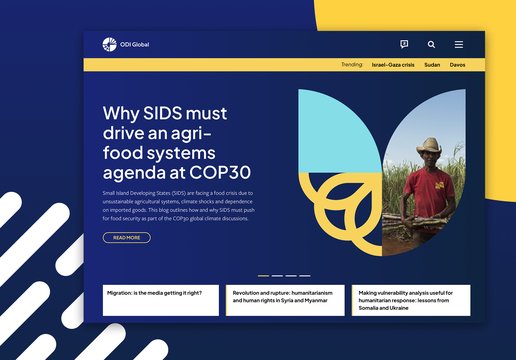
We often see vital insights trapped in a Where’s Wally-esque blur of clunky content. For independent think tank ODI Global, we transformed 16,000+ buried pages into a smart filtering search system.
For the Government Outcomes Lab at the University of Oxford, we made individual articles easier to read, with chapter markers, clear typography, and in-page progress indicators. By making a 10,000-word piece navigable, a busy policymaker can find a specific case study in seconds rather than scrolling for minutes. The content on these platforms didn’t change, but digital craft made it usable.

On Think Tanks exists to improve the quality of think tank work globally. Its platform is built for return visits, not one-offs: alongside articles and research, it runs a podcast, a jobs board, an open directory of think tanks worldwide, an annual conference, and a School for Thinktankers. To make it all navigable, the search feature allows you to filter across six clear themes: governance, communications, funding, research, policy impact, and understanding think tanks. Filter by theme and year and you go from 3,500 results to exactly what you need.
The digital lesson: Think about your content from the perspective of the person who needs it most. How do they find it? Do they understand it? Can they do something with it? If the answer to any of those is unclear, your work might be hidden.
Mission-led doesn’t mean identity-free
Your website might not be where people first discover you – but it’s often where they decide whether to trust you with their time, money, or attention. That moment deserves more than a template with your logo on it. Your platform should be a genuine expression of your mission and values, not a compromise with them.
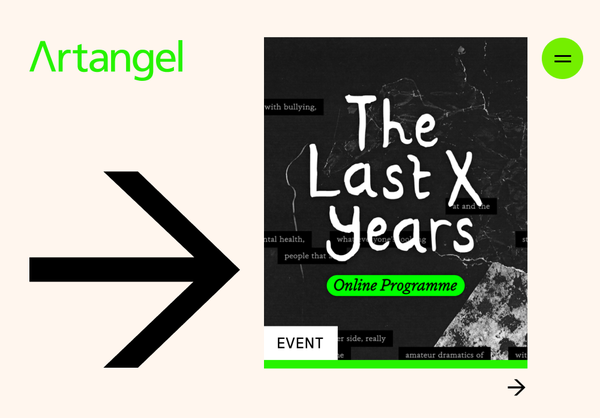
Take our client Artangel as an example. The nonprofit’s work defies categorisation, and its platform had to do the same. When its 30-year archive became impossible to find behind a site that needed a 60-page manual to operate, the team didn’t just want it fixed. They wanted it to feel unmistakably theirs. Now 80+ projects across 400 pages are discoverable, 300+ buried videos and audio clips are back in circulation, and the platform is still eccentric, still full of rabbit holes, still unmistakably Artangel.
The digital lesson: Just like the big brands, distinctive and consistent design identity builds familiarity and trust. And for mission-led organisations, trust is everything.
Design to reach the most unreachable
According to the 2026 WebAIM Million report, nonprofits and charities are the second best performing sector for web accessibility – better than education, better than health, better than media. And still, 95.9% of all homepages have detectable WCAG failures. The most common problems are low contrast text, missing image descriptions, and unlabelled form inputs.
A fast, simple, clearly structured site reduces the mental effort required to engage. For someone navigating a crisis, or with low literacy, or using a screen reader, that reduction in friction is the difference between finding help and leaving. When organisations design the entire digital experience from the viewpoint of those with the highest access barriers, it naturally makes the site easier to use for all.
The digital lesson: Who is your platform hardest to use for? Start designing from there.
“We need a new website” is not fundable
Every tactic in this piece – publishing without permission, digital sovereignty, designing for participation, making knowledge usable, expressing identity, reaching the unreached – is an argument for digital as infrastructure. Not decoration or a website, but a platform that enables your mission to travel further, reach more people, and keep going after the initial moment of attention has passed.
Funders that understand this are some of the most important digital changemakers in the sector:
CAST – the Centre for the Acceleration of Social Technology – works both sides of the equation: directly with charities to embed digital across their services and strategy, and with funders and sector leaders to create an environment that supports them to do it. Its Funder Plus model combines grants with hands-on support, so organisations receive money and the capacity to use it well.
Esmée Fairbairn Foundation funds capacity-building across arts, culture, education, and environment organisations, including digital.
The National Lottery Community Fund has made digital infrastructure fundable for community organisations – a significant shift in how the sector thinks about what counts as a legitimate use of grant funding.
The digital lesson: When making the case for digital investment – internally or to funders – lead with outcomes not deliverables. Which of these tactics does your organisation need most? What would it make possible? Who would it reach? That’s the argument worth making.
Be part of Digital for Change
As a specialist digital agency for charities, nonprofits, independent think tanks, and academia, we’ve spent almost 20 years helping mission-led organisations use digital platforms to make real-life change.
For us, it’s not just about what platforms they’re on, but what their online presence is doing in the world – what it makes possible that wouldn't otherwise exist, and how it moves people it wouldn't ordinarily reach.
We’re building Digital for Change: a living directory of organisations we think are doing this well, across investigation, advocacy, academia, ecosystem-building, and beyond. We're in the early stages and looking for entries – the organisations that will shape what this becomes.
If your organisation works in this space and you’d like to be considered, we'd love to hear from you.