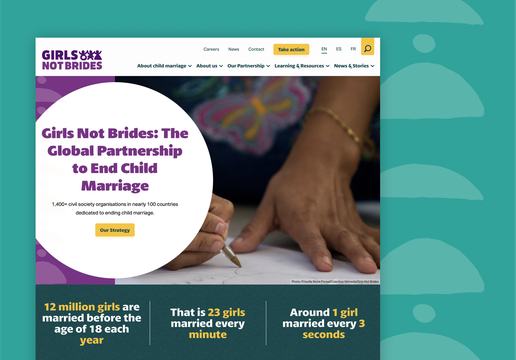
Cursive works with global charities to make sure their digital resources are as useful as the work behind them deserves.
Girls Not Brides’ Child Marriage Atlas – described by the charity as the only online source for child marriage data worldwide – wasn’t presented in a way researchers, journalists, and advocates could use and take action easily. We rebuilt the interactive data visualisation tool to better suit the charity’s needs, developing an experience that made sense to the user.
TL;DR – the top takeaways
Data that works for the people who need it
Interactive data visualisation that gives researchers, journalists, and policy advocates a clearer, faster route to data making the global case against child marriage.
A resource Girls Not Brides owns outright
The rebuilt code lives in the Girls Not Brides platform as their property – no retained rights, agency dependency, or risk of being locked out of their own tool.
A little background…
Founded in 2011, Girls Not Brides is a global partnership of more than 1,400 civil society organisations across nearly 100 countries, dedicated to ending child marriage. Its web platform is the movement’s central hub, and Cursive has supported it since early 2024. In that time we’ve rebranded the site, made the backend easier to work with, and integrated AI-powered translation across three languages.
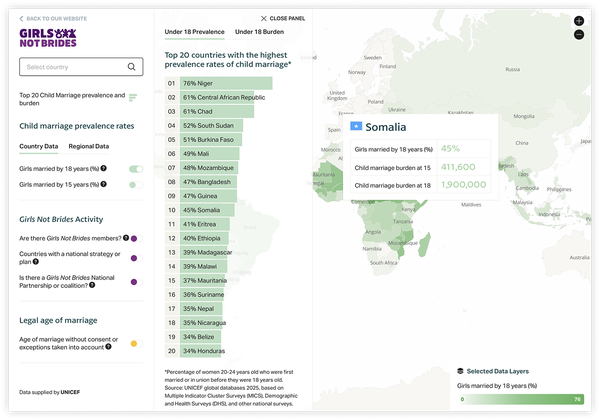
Among the most important tools on Girls Not Brides’ website is the Child Marriage Atlas: an interactive data visualisation drawing on UNICEF data to show prevalence rates, trends, and country-specific insights for child marriage around the world.
The challenge
When we first took on the wider Girls Not Brides platform, the Child Marriage Atlas was already established – built by a previous agency. But it wasn’t working as well as it could for the people who depended on it.
The Atlas needed to carry important information that spurred action among journalists, researchers, and supporters. But that action was being held back by the user journey. Data wasn’t as smooth as it should’ve been to access, and the presentation didn’t do justice to the quality of the research behind it.
There was another complication. The agency that built the original Atlas declined to share the source code — offering instead to take on the work themselves. For a charity that wanted freedom to develop its platform on its own terms, we needed to help the team at Girls Not Brides find an alternative solution.
The solution
Instead of negotiating access to code that wasn’t being offered, we rebuilt the Child Marriage Atlas in a way that put the Girls Not Brides team fully in control of an important feature of their site.
We designed for the user’s journey through the data as the starting point of the Atlas, rather than an afterthought. What does a researcher need when they land? What does a campaigner need before they share it? What does a journalist need when they’re under deadline? Those questions shaped our decisions about structure, navigation, and presentation.
Once complete, the code belonged to Girls Not Brides outright — no retained rights or ongoing dependency on us. It lives in their Wagtail platform the same way the rest of the content does. If the website ever moves elsewhere, the Atlas moves with it.
How we did it
The rebuilt Atlas is an accessible, full-screen, immersive experience – a significant step up from what was there before. Users can move between global and country-level views with an interface designed to make exploration feel natural.
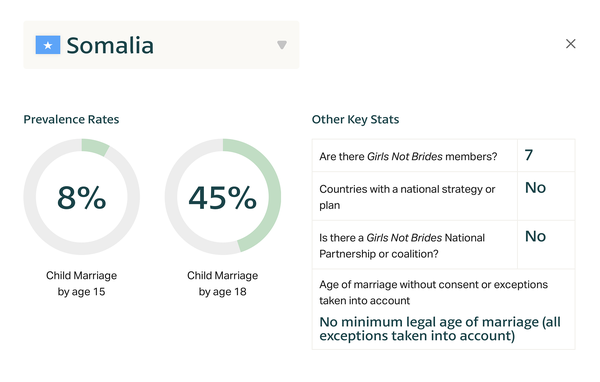
The interactive data visualisation lets users filter the information they need, whether that’s child marriage prevalence by country and region, national strategies and action plans, the legal age of marriage in each country, and where Girls Not Brides members are actively working. The Atlas works as a quick-reference tool for someone who needs figures fast, and the perfect starting point for someone who needs to go further.
Finally, we offered the code to be property of Girls Not Brides, rather than being something we would cling on to if the website ever went elsewhere.
What we learned
The Atlas was already doing important work before we touched it. But it wasn’t doing it as well as it could be. A tool like this – the only one of its kind globally – should make it easy for a campaigner to find what they need and share it in seconds. We made sure we understood what was holding it back and rebuilt it properly, giving Girls Not Brides ownership of its code so it wasn’t dependent on any agency in the future.