Most guides on how to choose a digital agency for your charity website will tell you to check for nonprofit case studies, ask about accessibility, and confirm post-launch support is included.
All true. But after nearly 20 years making, supporting, and amplifying web platforms for charities such as Barnardo’s, Dementia UK, and Girls Not Brides, we’d add a lot of questions that don’t make it into typical conversations.
Not because those things don’t matter. They do. But they only pick at the skin of a decision that goes much deeper. The agency that impresses in the pitch, delivers on time, and hands over a genuinely beautiful charity platform can still leave you with risks to wrangle alone.
One of the most expensive mistakes charities make isn’t choosing the wrong CMS or paying too much for a build. It’s choosing a charity web design agency that solves a temporary problem while missing the long-term pattern underneath it.
Before you start the search
You know more than you might think. You’re the one with direct experience of what your platform is like to live with, day to day, under pressure. Bring that into the room. Knowing the answers to these questions will help a good charity web agency work with you as a partner to figure out the best solution together:
Not we need to sort the website. Underneath that: are donations declining and you suspect the journey is broken? Is your content team spending half their week raising tickets for basic publishing tasks? Has your platform become a source of institutional stress rather than a driving force for the mission? The more precisely you can name the pattern, the harder it is for an agency to focus on the wrong problem.
Not just your supporters or donors. Your editors. Your researchers. Your comms team at 9pm before a campaign goes live. The policy officer who needs to update a page on their phone on the way to a select committee. The accessibility needs of the communities you serve. Specialist digital platforms are built around how people naturally use them every single day.
Volume, complexity, structure. How many pages? How many content types? Does your research need to be searchable and filterable? Do you publish in multiple languages? What about membership spaces? Do you have video, data visualisations, interactive tools? The answers determine what kind of platform you need – whether a standard template-based build does the job or whether you need something crafted for complexity.
How many people publish content? What’s their technical confidence? Will they have developer support for day-to-day tasks, or do they need to be fully self-sufficient? A web platform that requires a dev to update a staff page is not a platform built to empower editors.
The most useful thing you can bring to a new agency conversation is an honest account of what could’ve been better the last time. Not as a warning or a whinge – as a diagnostic. Did the agency disappear post-launch? Did the CMS turn out to be harder to use than promised? Did the scope expand in ways nobody managed properly? Did the platform become outdated faster than expected?
The pattern that broke the last relationship is usually the pattern you most need your next agency to handle differently.
Launch day is the beginning, not the destination. A platform that looks perfect on go-live but can’t evolve with your organisation, can’t absorb new editorial requirements, and can’t be amplified without someone who speaks fluent code is a platform with a countdown clock on it. It’s worth thinking about what your platform needs to do in 2030 – what your organisation will look like, what your content demands will be, what your team’s capacity will realistically allow.
This is the question most organisations underanswer, and most agencies underask. The build is one cost. The ongoing support, maintenance, security, accessibility, and evolution is another – and it will run for years. An honest budget conversation includes both. Once you’ve figured it out, many clients prefer not to share their budget with the agency too early on in the conversation – we get it. But even if you can share goal posts, it means the focus can be on realistic, attainable solutions instead of guesswork.
The reality your charity web agency needs to understand
74% of UK charities say digital is a medium or high priority, but only 44% have a digital strategy. This gap lands on specific people, in specific roles, with specific consequences. Someone is carrying the weight of digital delivery without the budget, capacity, or support to do it properly. They’re fielding questions from leadership they can’t answer confidently. They’re watching technical debt accumulate while maintenance budgets disappear. Competing not just with other causes, but every other brand, publisher, and creator on the internet vying for people’s attention. And they’re managing a relationship with a charity web development agency that shifted from proactive partnership to reactive ticket-handling somewhere along the way.
The right digital partner understands this context before you brief them.
Six questions to ask a charity web design agency
Real sector fluency understands what it takes to run a platform where, as one nonprofit web owner told us, “there is stuff coming in every day – high content turnover – so when the senior leadership team asks what’s happening, it’s more stress for me.” It looks like having built a search feature that allows policymakers to easily sift through 16,000 pages. It looks like understanding that editorial confidence and supporter trust isn’t secondary. When content teams can’t publish without raising a ticket, and funders can’t donate without a security flag, it’s the mission that suffers.
A good charity web agency gets the pace of your turnarounds, the purpose of your platform, and the pressure you’re under – and they care about what happens next.
The pattern we see most often in the charity sector isn’t a bad build. It’s a good build followed by an agency that ghosts. What was once a collaborative relationship becomes transactional. The project team moves on to the next pitch. Support gets handed to a different team. Requests disappear into a ticketing void.
We call this drift – and it is, in our experience, the most common and most frustrating of the four platform failure patterns we see repeating across mission-led teams.
The Charity Digital Skills Report 2025 found that 50% of charities report being poor at resourcing digital work, and 24% struggle with inadequate IT support. When internal capacity is already stretched, an unresponsive agency is worse than just inconvenient – it can make your original problem even worse.
A good charity web agency should have clear response times – either the same or next day. You should see the backlog, plan, and deliverables. Get proactive advice that arrives before you ask for it. When leadership asks what’s going on with the site, you can explain what’s being worked on and why, easy.
Ask specifically: who is our named contact six months after go-live? What’s your response time for a critical issue on the morning of a major campaign launch? Do you proactively flag problems – or wait for us to raise them?
There’s no point building a CMS people can’t use. Publishing needs to be painless so missions can move forward. No plugin chaos, no confusing dashboards, no ‘hope this doesn’t break the homepage’ headaches. It’s important that your charity CMS is clean, fast, and delightfully editor-friendly, so editors can get in, do their job, and move on with the mission.
What matters here is that your charity web agency is honest about what you need today vs what you need down the line. For instance, if you know your content hub will eventually contain hundreds of insights, articles, and reports, so naturally, you spec advanced filters, pagination, and search functionality. But at launch, your editors have five articles ready to publish. Those features aren’t just unnecessary – they can be actively unhelpful, adding complexity to the build, eating budget that could have gone toward accessibility or search optimisation, and creating maintenance overheads for functionality nobody uses yet.
Future focus is fundamental, but aspiration can get in the way of what’s needed today. Ask your editors what they truly need right now, then make sure your agency can tailor to their real-life workflow.
A good charity web design agency should be able to tell you clearly why they’ve chosen the tech stack they have. And the answer shouldn’t be because it’s what we know or because the client asked for it.
WordPress is the default for many charity web agencies – good ones included. If your site is genuinely simple, it may be the right choice. It’s widely supported, familiar to lots of developers, and easy enough to edit once it’s set up. For a small charity with straightforward content needs and a limited budget, it can be a decent setup.
The thing is though, WordPress is popular. That popularity makes it well supported and versatile, but also increases its exposure to security risks. Many charity websites follow ‘build‑then‑neglect’ pattern documented in the UK’s State of Digital Government Review 2025, where initial development is funded but long‑term maintenance isn’t. Over time, unsupported plugins, outdated themes, and limited technical oversight can leave organisations reliant on legacy infrastructure that’s expensive to fix and difficult to secure.
If you’re managing complex content, multiple editorial teams, high publication volumes, research repositories, policy portals, or mission-critical donation flows – the case for a more robust platform is strong. And the long-term cost comparison looks very different from what the initial proposal suggests.
We use an open-source CMS called Wagtail, built on Django (a highly secure Python framework). Not because it’s what we’ve always done, but because after nearly 20 years solving hard platform problems for mission-led organisations, it consistently outperforms the alternatives on the things that matter over time: security, editorial flexibility, scalability, and longevity.
It’s worth knowing that Wagtail isn’t a niche or experimental choice. It powers the NHS, NASA, and Google. Amnesty International runs on it. So does the Mozilla Foundation, the British Red Cross, and our client: The Government Outcomes Lab at The University of Oxford – organisations that need platforms to handle complexity at scale without becoming a liability.
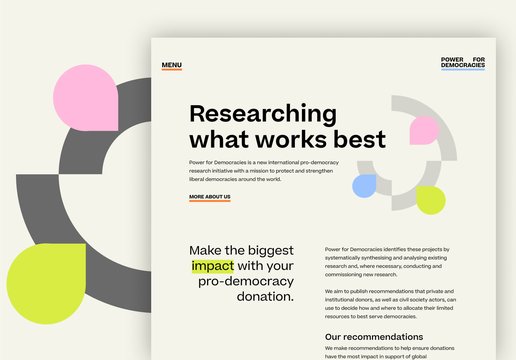
We love it because it’s infinite in what it allows us to create. For instance, when Power for Democracies needed a brand-new research platform live in six weeks – with a non-negotiable requirement for EU-only hosting and no major Big Tech infrastructure – Wagtail made it possible.
The right charity web development agency asks in-depth, practical questions before they start designing. Why now? What’s the impact of doing nothing? Is this a platform problem or a process problem? Are you optimising for your most common user or your most important donor?
And sometimes – if they’re being genuinely truthful – they’ll tell you that you don’t need what you’re asking for. That the rebuild you’re planning is a symptom of a deeper pattern. That the right answer this year is stabilising your platform, not adopting another AI tool.
This is not a smaller agency being modest. This is an experienced one being honest about something the sector is only beginning to reckon with: most mission-driven organisations don’t need more rebuilds. They need platforms that are resilient, manageable, and supported by partnerships that are responsive, proactive, and built for the long term.
Content migration is a high-risk phase where agency transitions can fail – not from lack of skill, but from lack of rigorous planning. Switchover day arrives: a site with 500+ pages and media-heavy content goes live. Within hours, dozens of images have disappeared. Media files weren’t properly mapped to the new CMS structure. Donation page graphics are broken. Archive content shows empty placeholders. Your supporters see 404 errors and distorted layouts. Your team is fielding complaints they can’t answer.
There’s no reliable undo button for this. Good migration looks like: multiple test runs to staging before go-live, every content type verified, all old URLs mapped to new locations to protect your SEO, a documented rollback plan, active monitoring for 48-72 hours after switchover, and migration issues fixed immediately (and included in the transition cost).
The four patterns driving charity platform stress
It’s worth understanding which of the following patterns is driving your current situation. You may recognise elements of all four, but identifying the primary pattern can influence how you choose a digital agency for your charity website.

Neglect – platforms are funded as a one-off project, then starved of ongoing investment. Security updates pile up. Accessibility issues go unfixed. Performance degrades slowly and invisibly. By the time the pain is acute enough to justify action, you’re facing an expensive rescue rather than a manageable, steady fix.

Overbuild – ambitious specs that exceed the organisation’s current capacity to use or maintain. Complexity creates burden instead of enabling the mission. Features nobody uses. Editors reverting to workarounds. Budget spent on sophistication that won’t be needed for two years, if ever.

Drift – a good build followed by an agency that goes quiet. Proactive partnership becomes reactive ticket-handling. Nobody is thinking about your platform between requests. Improvements happen in response to whoever escalates loudest, not what will genuinely move the mission forward.

AI spiral – pressure to adopt AI without governance, clear use cases, or platform foundations to support it. Six months in: editors don’t trust the outputs, privacy concerns surface, and subscriptions aren’t delivering the promised time savings. The Charity Digital Skills Report 2025 found that 76% of charities are using AI tools – but only 2% are using AI strategically. The pattern that works, as we saw at Wagtail Space 2025, is governed experimentation: stabilise foundations first, pilot with specific use cases, scale only where it demonstrably reduces workload.
Your mission depends on making the right choice
Don’t let a charity web agency push you into one specific platform. They should lay out the best options for you, even if it means you don’t end up working with them. Because deciding which CMS to use depends on what you’re building, who’s maintaining it, and what it needs to do.
Charities doing well digitally in the next few years won’t necessarily be the ones spending the most. They’ll be the ones that stopped treating platforms as a one-time spend and started treating them as the most valuable asset they have – with continuous care. They’ll have big brand strategies that show people what they stand for before they've even read a word.
That shift changes how you budget: a steady investment rather than sharp rebuild cycles. It changes how you brief: outcomes rather than features. It changes what you look for in an agency: a consultant or partner who understands your mission and will still be there when things need to evolve, not a supplier who delivers a specification and invoices.
With a 92% client retention rate over the last five years and nearly 20 years building platforms for mission-led organisations, we’ve seen what happens when this relationship is right – and what it costs when it isn’t. We’re a small, senior team with deep Wagtail and Django expertise, genuine sector knowledge, lived advocacy experience, and a commitment to staying involved long after launch.
We don’t just build and walk away. We care about what happens next. And that’s the thing our clients tell us matters most.
Not sure what your platform needs?
Before you talk to any charity web design agency – including us – it’s worth knowing exactly where your platform stands.
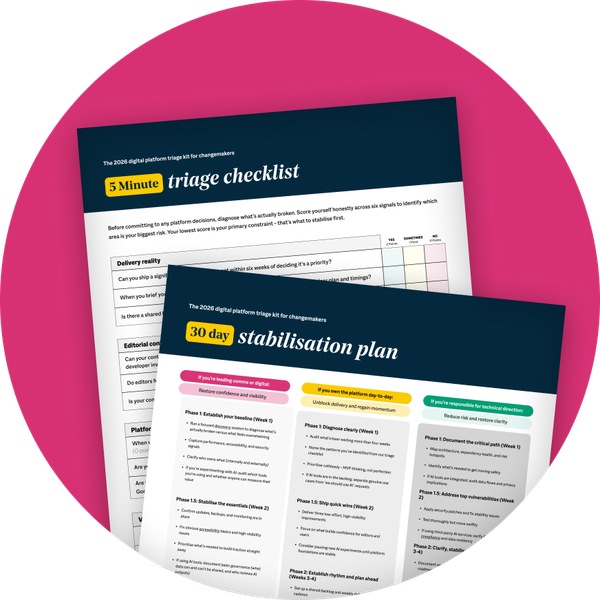
The free 2026 Digital Platform Triage Kit takes five minutes. It gives you a scored diagnostic across six areas, and identifies which of the four patterns is driving the most stress and risk. And it gives you practical next steps to stabilise your platform in 30 days.
Or if you’d rather a second pair of eyes on your specific situation, send us your site and your biggest headache – we’ll reply with the first three fixes we’d make.